Everyone wants a number. How many days until the fans come out and the room can be put back together? This guide gives typical ranges and explains what moves a job toward the short or long end.
Typical ranges
| Material | With professional drying | Left to dry by itself |
|---|---|---|
| Drywall, clean water, caught early | 3 to 4 days | Weeks, often with mold |
| Wood framing and plywood subfloor | 4 to 6 days | Many weeks |
| Carpet, with pad removed | 2 to 3 days | Unreliable |
| Hardwood flooring | 7 days to several weeks | Months, usually with damage |
| Plaster on lath | 1 to 3 weeks | Months |
| Concrete slab or block wall | 1 to several weeks | Months |
These are common ranges, not commitments. Every job is confirmed by moisture readings.
What "dry" means
Dry does not mean no moisture at all. Wood and drywall always hold some. A material is considered dry when its moisture content matches the same material in an unaffected part of the same building. That reference reading is called the dry standard.
So the test is a comparison. A reading is taken on a dry wall, then on the wet one, each day until they match.
What sets the clock
- How wet it gotA splash and a three-day soak are different starting points.
- How long before drying beganEach day of delay lets water move deeper.
- The materialDense materials such as hardwood and plaster release water slowly.
- Air movementFast air across the surface carries moisture away.
- HumidityDry room air pulls moisture out. Damp air does not.
- TemperatureWarmth speeds evaporation. A cold building dries slowly.
- AccessAn open cavity dries faster than a closed one.
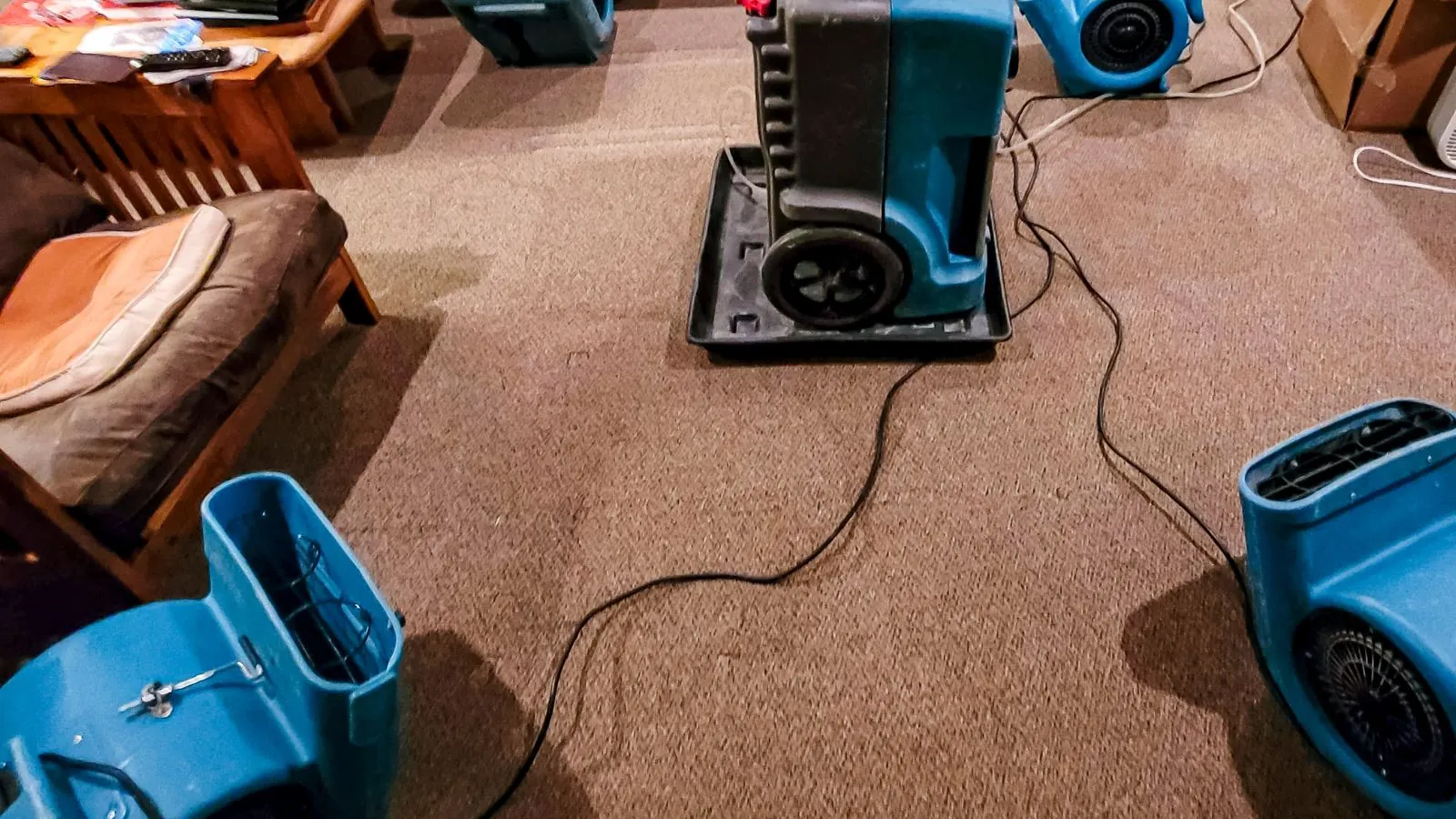
Professional drying controls the last four. Air movers supply the airflow. Dehumidifiers keep the air dry. Heat is maintained. Baseboards and small openings give the air a path.
What not to do while it dries
- Do not switch the equipment off overnight
- Do not open windows on a humid day
- Do not put rugs or furniture back on a floor that is still being dried
- Do not paint or caulk over anything damp
Why fans alone are slow
A household fan moves air but does not remove moisture from the room. Water leaves the wall, enters the air and stays there. Once the room air is humid, evaporation slows to a crawl. A dehumidifier is what keeps the process going.
Opening windows can substitute on a dry, breezy day. On a damp one it adds moisture.
The stages of a drying job
- Day one: extraction, removal of materials that cannot be saved, equipment placed, first readings recorded
- Days two and three: quickest progress. Surface moisture goes first
- Days three to five: slower progress as deep moisture works outward. Equipment is repositioned
- Final day: readings match the dry standard. Equipment is removed
- Afterward: repairs begin
Equipment runs around the clock. Turning it off overnight stretches the job.
Why rebuilding too soon backfires
Closing a wall over damp framing traps moisture behind new drywall and paint. Laying flooring over a damp slab or subfloor leads to cupping, adhesive failure or mold beneath it. Waiting two more days for a clean reading costs less than redoing a floor.
Hardwood is the extreme case. Boards must return to normal moisture content before sanding, and that can take weeks after the equipment is gone.
What Changes The Timeline In Westport
Location affects drying, and three local conditions come up often.
Humidity is the first. The town's own description sets Westport on two branches of the Westport River with beaches facing open water. In summer the outdoor air is damp, so houses are kept closed during drying and the dehumidifiers do the work.
Unheated buildings are the second. The town says summer residents raise the population by nearly a quarter, and its 2025 Housing Production Plan counts 7 percent of the town's homes as seasonal, on Census figures. A closed house in February with no heat will dry very slowly until heat is restored. That adds days.
Older construction is the third. The Westport Historical Society notes that many Main Road buildings have been in continuous use since the 1800s. Plaster and thick old timbers sit at the slow end of every range in the table above. Source types: the town's description, the town housing plan and the local historical society.
Signs it is not dry yet
- A surface that feels cool to the touch compared with the wall next to it
- A musty smell that returns on humid days
- Paint that bubbles or baseboards that swell after the repair
- Flooring that continues to change shape
- Condensation on windows in that room
Can you speed it up?
To a degree. Start early. Remove wet carpet pad and insulation. Take baseboards off. Keep the room warm and closed with a dehumidifier running. More equipment helps only up to a point, because water still has to travel from the middle of the material to its surface.
Where to go from here
If you are a week past a leak and unsure, readings will settle it in a few minutes. Our structural drying page explains the equipment, and hardwood floor water damage repair covers the material that takes longest. We serve Westport and nearby Acushnet and New Bedford.